Code Over Trust: The Case for Smart Contract Escrow

Every deal has a trust problem. Someone has to hold the money and whoever holds it has a reason to cheat. Smart contract escrow solves that in a way no bank, lawyer, or handshake ever could.
What is a smart contract escrow?
Imagine you and your friend make a bet. If Arsenal wins on Saturday, you get $50. Tottenham wins, your friend gets $50. Neither of you wants to hand the money to the other. You both know how that ends.
So you call over a third friend and say: “Hold this $100. If Arsenal wins, give it to me. If Tottenham wins, give it to him. If it's a draw we both get our money back.”
That third friend doesn’t support either club. He doesn’t owe either of you a favor. He just executes the rule you both agreed to, the moment the final whistle blows.
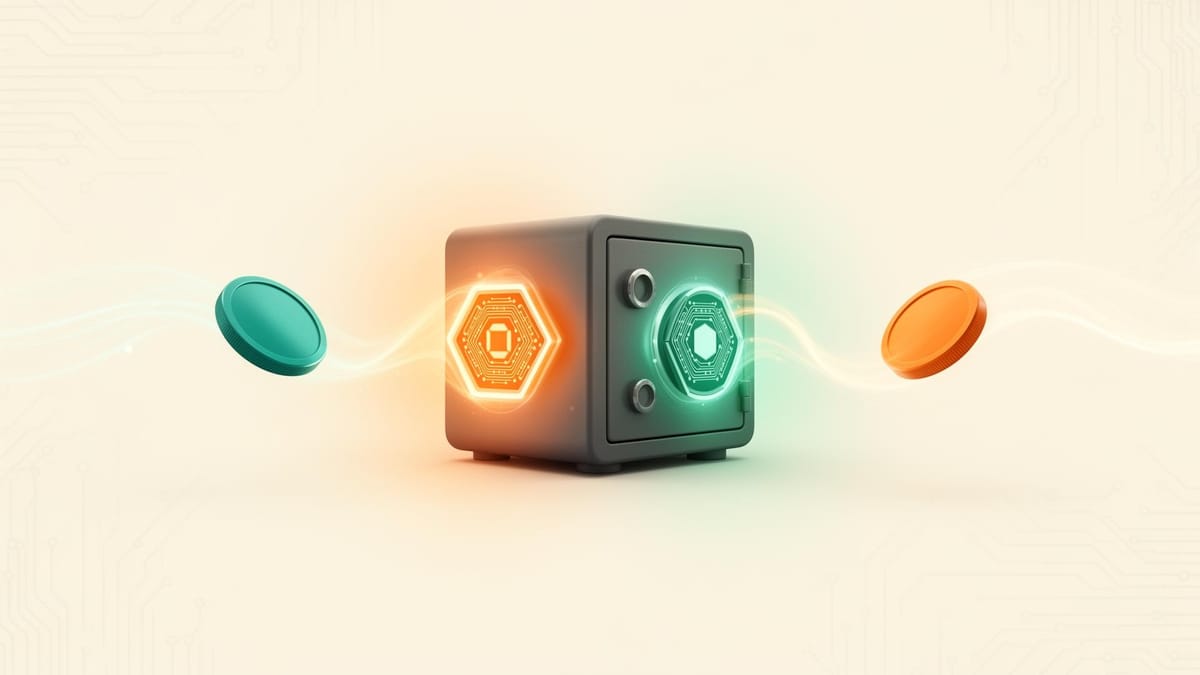
A smart contract escrow is that third friend. Except it's stateful code that lives on a blockchain – and it's better than any friend you've ever had. It can't be bribed. It can't be sweet-talked. It never sleeps, never makes exceptions, and behaves exactly the same way every single time.
Why not use a normal escrow?
Traditional escrow has been around for ages. It works well enough. So why change it? Let's look closer.
Traditional escrow runs on manual processes: humans reviewing documents, approving releases, coordinating transfers. And humans keep human hours. Weekends off. Public holidays off. Your urgency is not their problem.
All of that manual overhead has a cost. Traditional escrow only makes economic sense when the stakes are high enough to justify it. A $50 bet between friends? A small cross-border payment? The fees alone would swallow the transaction. For everyday people making everyday transactions, it was never really an option.
Even for larger transactions things can become complex. Every lawyer, bank and platform handles their own piece differently. Even with full access to everything, piecing it together is a job in itself. And when something goes wrong, that fragmentation makes it difficult to predict how things will play out.
And then there's the deeper problem. A traditional escrow agent is a single point of failure. You are trusting one institution, one person or one platform with your money – and everything they do with it happens behind closed doors. If they're negligent, incompetent, or outright corrupt, your only recourse is a legal battle. Which is expensive. Which takes time. Which they know.
What makes a smart contract escrow better?
A smart contract is simply code, and that changes everything. It has advantages that traditional escrow simply can't match.
The most obvious is automation and programmability. A smart contract can be programmed like any other software system and runs on the network (Ethereum, Base, etc) it was deployed. No manual steps or waiting for approvals. Everything for every party lives inside a single contract. No fragmentation, no handoffs, no gaps.
Because it runs on a public blockchain, the code is open for anyone to read, verify, and test. Unlike a legal document, you can copy a smart contract, deploy it to a testnet, and simulate exactly how it behaves before a single cent is committed. And every interaction is recorded on-chain permanently — so you can look back at how similar situations played out and know with certainty yours will play out the same way. No closed doors, no legalese, no he-said-she-said. If anything goes wrong, the record is right there.
Then there's cost and speed. Because smart contract interactions are so inexpensive, small transactions become completely viable. The $50 bet from our example? Perfectly reasonable. Fast to settle and cheap to run.
One caveat
Smart contracts work best when the data they rely on is publicly verifiable. The final score of an Arsenal match? Easy. A piece of software called an oracle reads the result from a trusted public source and feeds it into the contract automatically.
But not everything is public. M-PESA (mobile wallet) transactions, for example, are private. There’s no on-chain record WireMe can tap to confirm a payment landed. So instead of an oracle, WireMe relies on the recipient confirming receipt directly. It’s a manual but necessary step given how M-PESA works.
To handle disputes, WireMe has built an override process for cases where the two parties disagree. And because every action still happens on-chain, the full transaction history is visible and traceable. WireMe can intervene but it can’t hide. We still must be accountable to the truth.
Real world uses
Smart contract escrow unlocks use cases that were previously too slow, too expensive, or too fragmented to be practical. Cross-border payments. P2P marketplaces. Crypto-to-fiat rails. Anywhere trust between strangers needs to be enforced without a middleman in the room.
This is exactly why WireMe is built on smart contract escrow. It reflects what we believe — that trust should be built into the system, not borrowed from an institution. And it gives our users something traditional escrow never could: a fast, cheap, transparent experience that works for everyday transaction sizes.
But this is just the beginning. The same foundation that powers a P2P marketplace today can scale to handle far more complex transactions tomorrow. We’re only getting started.
The third friend
It would be great if people could be trusted like code. But a friend that predictable wouldn’t be much fun at a party. Keep your friendships exciting. Keep your finances boring. Let the math handle the money.