Understanding the Non-Custodial Payment Framework

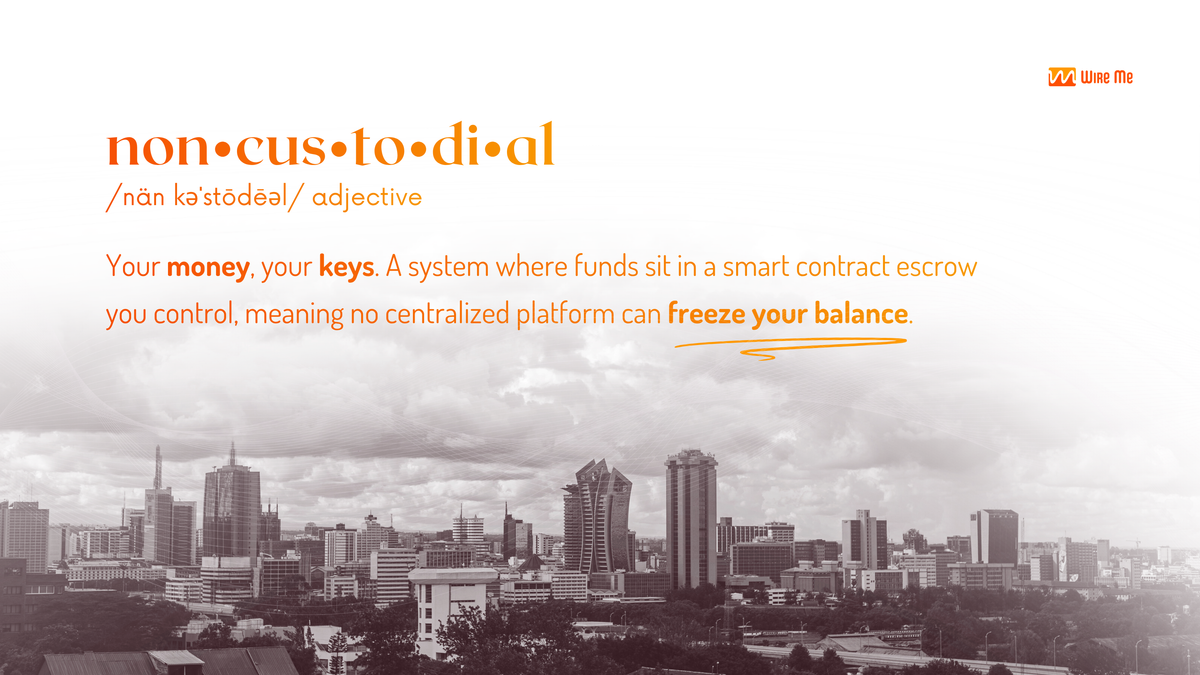
The word non-custodial seems very technical but it's a very simple concept about logistics and control. It answers one basic question: when a client pays you, who controls that money?
If you are a freelancer, remote builder, or agency owner in Nairobi servicing global clients, understanding this distinction is the difference between owning your cash flow and letting a corporation control your operations.
We are stripping away the blockchain jargon to break down what non-custodial actually means, how it eliminates platform freezes, and why it is the only architecture that guarantees you get paid on time.
1. The Cost of Centralized Custody
In a standard custodial setup, your operations work like a traditional bank vault. When an international client pays you, the money does not come straight to you. It is deposited into the platform (such as Paypal), and your account balance reflects that change..
This design introduces severe counterparty risk into your business:
- Asymmetric Control: Because the platform controls your corporate accounts, they retain the right to freeze balances or block withdrawals based on their risk algorithms.
- Compliance Bottlenecks: Routine compliance reviews or sudden policy changes can trap vital operational capital for days with zero human recourse, usually right before the weekend.
- Predatory Fees: Middleman extract value at multiple layers, compounding high base transfer percentages with unfavorable exchange rate spreads.
When an enterprise can freeze your account to protect its own liability, you are the one carrying their operational risk. For an agency trying to scale or a developer with global clients, that is a structural hazard you should not have to live with.
2. Under the Hood: The Smart Contract Escrow
Non-custodial architecture eliminates the middleman entirely by replacing human intermediaries and centralized databases with programmable blockchain infrastructure. Instead of trusting a corporate entity, the transaction terms are embedded directly into immutable code.
When you process a client payout through a high-performance bridge like WireMe, the payment lifecycle shifts completely:
This protocol guarantees that code is law. The underlying platform functions strictly as an interface layer, not a gatekeeper. Because the digital assets are held within an independent cryptographic escrow rather than a centralized balance sheet, your liquidity remains entirely sovereign throughout the fulfillment cycle.
3. What This Means for Your Cash Flow
For tech ecosystems and remote talent hubs navigating global markets, moving to a self-controlled payment model is a matter of business longevity. Operating on infrastructure that can be altered or shut down without warning limits your capacity to scale securely.
Deploying programmatic settlement rails ensures your business enjoys clear financial advantages:
- Predictable Runways: Eliminating arbitrary verification holding windows allows businesses to optimize capital allocation and meet local operational expenses precisely on time.
- True Asset Ownership: Your treasury is secured by mathematics and decentralized network validation, sheltering your enterprise from external policy updates or counterparty downtime.
- Direct-to-Local Clearing: Bridging global digital USD directly to M-PESA rails bypasses traditional multi-tiered banking routing, keeping your conversion processes highly efficient.
Sovereignty over your incoming treasury is no longer an experimental feature. It is a fundamental operational necessity. By implementing non-custodial infrastructure, modern builders protect their business continuity, neutralize platform vulnerabilities, and take full control of their global distribution.
Take Control of Your Global Cash Flow
Stop allowing centralized platforms to dictate your operational runway. Protect your agency or freelance treasury from arbitrary blocks, settlement latency, and hidden middleman fees.
Deploy a self-controlled payment engine built for the borderless economy.