What brokers should actually ask before trusting any P2P platform
The freeze wave changed P2P trading in Kenya. Here is a candid breakdown of what non-custodial escrow actually solves, how WireMe handles VASP Act compliance and DCI requests, and where our platform protection ends.

In part one, we laid out why the real risk for Kenyan P2P brokers in 2026 isn't a single bad trade anymore. It's that a clean trade can go bad weeks later. And the platform locks you out before anyone asks for your side of it.
That reality should change what brokers ask of any platform they work with, including us. Here's how we think about it.
What identity matching and escrow actually solve
Go read any P2P advertiser's terms and you'll see the same rules typed out by hand. No third-party payments. Name must match. Don't release until it clears. Every broker writes them because every broker has been burned without them, and every broker still has to enforce them personally, trade by trade.
WireMe builds them in. The registered name, M-PESA line, and transaction destination have to match on both sides before a trade can proceed, and brokers set their own escrow window so funds don't release until a payment has truly settled. Same rules. The difference is they're conditions of the trade now, not a request in a text box.
We want to be precise about what this does and doesn't do. It confirms the person paying is who they say they are. It doesn't tell you where their money came from before it reached the trade. No identity check does, and on the shilling side, no P2P platform can. The money moves directly between two M-PESA wallets. Nobody sits in the middle of that leg, us included. Any platform claiming otherwise is overselling.
The stablecoin side is different, because it settles on a public chain. We're building AML risk scoring into WireMe so a broker can see where a counterparty's stablecoins have been before agreeing to a trade.
Why non-custodial design matters here
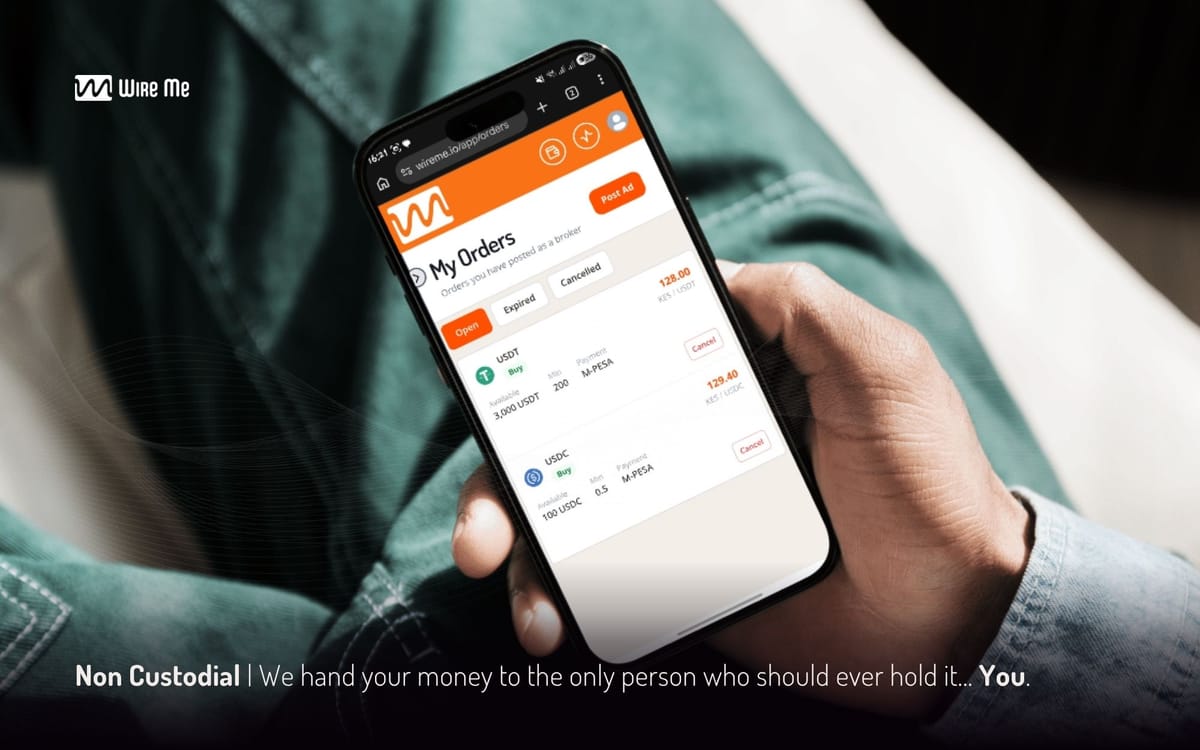
Non-custodial design matters because it means that we can’t freeze or restrict your funds. WireMe never holds a broker's funds. Trades settle on Base directly into a wallet only you control, so even if we were ordered to freeze your account, we simply can not.
That also makes WireMe easy to add without affecting your existing setup. A broker can easily move float between WireMe and their accounts on Binance, OKX or any other platform. They can move capital to wherever demand is that day, with no withdrawal queue or platform approval sitting in between. Most brokers already work across several venues. WireMe is built to be one of them, not a switch you have to make all at once.
The questions we think brokers are right to ask
What is WireMe's compliance and licensing position under Kenya's VASP Act?
WireMe operates as a non-custodial software platform that matches independent brokers with clients. It never takes custody of virtual assets or fiat, and it is never a counterparty to any trade, buyers and sellers interact directly with a smart contract escrow and with M-PESA, and WireMe touches neither leg of the transaction.
Under the Virtual Asset Service Providers Act, 2025 and its 2026 Regulations, licensing attaches to the intermediary who actually touches client funds, not to the platform that merely connects two parties. On that basis, WireMe Inc. itself is not required to hold a VASP license; the individual brokers operating on WireMe's platform are, as each is separately licensable as a Virtual Asset Broker with the Capital Markets Authority.
This position is not yet confirmed in writing by CMA. The next step is to formally request a letter of no-objection from CMA confirming this reading, which converts the current interpretation into something WireMe can rely on for compliance verification going forward.
If law enforcement requests information about a broker's activity, what is WireMe's process, and what does the broker get told, if anything?
WireMe does not disclose broker information to Kenyan authorities, DCI or otherwise, based on a request alone. As a US entity, WireMe Inc. can only be compelled to produce data through US legal process. A Kenyan agency seeking broker information must obtain that process via one of the recognized international channels, a Mutual Legal Assistance request, letters rogatory, or a US court order under 28 U.S.C. § 1782, resulting in a US subpoena, court order, or warrant. Absent that, WireMe will not produce broker data, and will direct the requesting agency to pursue one of those channels.
If WireMe does receive and comply with valid US legal process, the affected broker is notified of the request and what was disclosed, unless the accompanying court order specifically prohibits notice, in which case notice is given once that restriction lifts.
Does WireMe do anything to assess source of funds beyond identity matching, and if not, is that being built?
For Kenyan shillings, these funds are never received or interacted with by WireMe. They are sent directly from one user's M-PESA wallet to the other's, so we cannot assess the source of funds.
For stablecoins, we are developing integrations with blockchain analytics and AML risk scoring services to determine the risk of the stablecoins being transacted.
If a counterparty disputes a trade after release, what recourse does a broker have, given there's no custodial intermediary to appeal to?
Custody isn't what settles a dispute. Evidence is. The burden falls on whoever says they sent the money: the buyer of the stablecoins, broker or client, emails their M-PESA statement to statements@wireme.io, straight from the M-PESA app, with the PIN that opens it. We check it against the trade and make a ruling.
Where this leaves brokers
We'd rather you leave knowing what we solve and what we don't than sign up thinking we've removed a risk we haven't. The freeze wave this year didn't happen because brokers got careless. It happened because a matching name and a clean-looking payment stopped being enough. Any platform worth trusting now has to say plainly where its protection ends.
See where WireMe stands, and where we're still building. Get started at wireme.io