How to Receive Upwork Payments in Kenya Without Losing Fees


You worked the hours. You revised the deliverables. You hit every milestone on time. Then Upwork releases the funds, and the moment that money touches the legacy financial system, it starts disappearing.
Not in one clean, visible transaction. In cuts. Thin slices taken by platforms you barely chose, at rates nobody told you about, through a chain of intermediaries that exist solely because nobody built anything better. Until now.
This is the exact breakdown of where your Upwork money goes, and how Kenyan freelancers in 2026 are finally plugging those leaks.
The Real Cost of Getting Paid in Kenya
Most conversations about Upwork fees stop at the platform's withdrawal charge. That's the smallest problem. Here is where the money actually disappears when you withdraw to Kenya through traditional rails:
1. The Withdrawal Fee (The Visible One)
Upwork charges a flat fee the moment you initiate a transfer: roughly $0.99 for local bank transfers, or $2.00 or more for third-party platforms. Annoying, but survivable. The real damage starts next.
2. The FX Haircut (The Invisible Theft)
This is where the bulk of your earnings quietly vanish. Banks and payment platforms do not give you the real mid-market exchange rate. They set their own rate, typically KES 4 to KES 7 below the actual market rate, and pocket the difference.
If the true rate is 135 KES per dollar and your bank buys at 129, you lose KES 6,000 on a single $1,000 withdrawal. No notification. No line item. Just gone.
3. The Incoming Wire Fee
Route your USD directly to a local Kenyan bank account and there is often another charge waiting. Some clearing banks levy an incoming wire fee on top of everything else, and your funds can sit in a compliance review queue for 24 to 48 hours before you can touch them.
4. The M-PESA Off-Ramp Fee
Finally, moving the money from your bank or digital wallet to M-PESA where you can actually spend it triggers a final round of transaction costs.
Stack all four layers together and the average Kenyan freelancer is losing between KES 3,000 and KES 8,000 per withdrawal. On a mid-tier monthly income, that's a significant tax you never agreed to pay.
Note for Fiverr and Multi-Platform Freelancers: While this guide uses Upwork as the primary example, the exact same hidden leaks apply if you are trying to move earnings from Fiverr, Toptal, Freelancer, or direct international client invoices. The legacy banking system treats all global digital inflows with the same inefficient friction.
Why This Is Still Happening in 2026
The short answer: the system was not built for you.
International correspondent banking infrastructure was designed for corporate treasury departments moving large sums on predictable schedules. It was not designed for a UX designer in Westlands or a software developer in Kilimani getting paid by a client in San Francisco for remote work done over three weeks.
The friction is not a bug. For the banks sitting in the middle, it is the product.
The only way to stop losing fees on Upwork payments in Kenya is to stop using the infrastructure that charges them.
How WireMe Fixes the Problem at the Infrastructure Level
WireMe does not layer a better UI on top of the same broken rails. It routes your money through a different system entirely. Here is what changes:
- No correspondent banks in the chain. WireMe settles through verified stablecoin liquidity (USDC), which is dollar-pegged and moves at the speed of a digital network, not a bank's compliance queue.
- A competitive marketplace. WireMe doesn't dictate a fixed, low-ball rate to you. Instead, you enter the amount you want to cash out, and verified liquidity providers compete for your transaction. You retain the power to choose the highest bid.
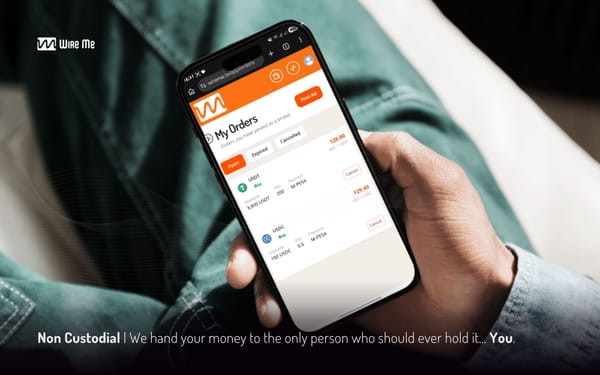
- T+0 settlement. Your money hits M-PESA in under 20 minutes. Not 48 hours from now. Not after a compliance flag review. Now.
- No account freezing risk. WireMe is purpose-built for Africa's remote workforce. You are not an edge case the system has to accommodate. You are the core use case.
Step-by-Step: How to Receive Upwork Payments in Kenya Without Losing Fees
Step 1: Set Up Your Digital Dollar Wallet
Connect your Upwork payout method to a digital wallet that accepts USDC stablecoins. When you withdraw from Upwork, your funds land in that wallet at a strict 1:1 dollar peg. No forced conversion at a bank's rate. No FX haircut before you even decide where the money goes.
Step 2: Name Your Amount and Watch the Market Compete
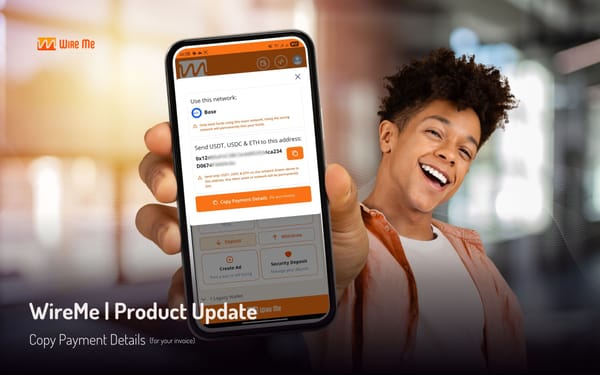
Go to WireMe.io and enter the amount of USD you want to cash out. Instead of accepting a single, predetermined corporate rate, our marketplace goes to work. Verified liquidity providers immediately send competing bids for your transaction. Look at the incoming offers, pick the absolute highest rate, and confirm. What you accept is exactly what lands in your account, with zero hidden platform margins.
Step 3: Enter Your M-PESA Details and Confirm
Input your M-PESA number. WireMe processes the transaction through its secure liquidity infrastructure and settles directly to mobile money. The funds clear in under 20 minutes. No waiting period. No freeze risk. No follow-up call to your bank.
What This Actually Looks Like in Numbers
The Bottom Line
You are operating at the speed of the internet. You are collaborating with clients across multiple time zones, delivering work on tight deadlines, and building a reputation in a competitive global market. Your payment infrastructure should match that pace.
Every month you use a legacy rail to receive your Upwork earnings in Kenya is another month of paying a tax you should not owe, to intermediaries you never chose, for a service you do not need.
WireMe was built to end that.
Brief your earnings home today, without the fees. Start on WireMe.io.