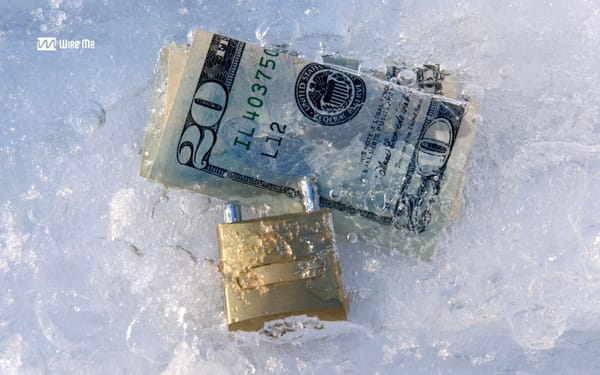
Stop Getting Your Funds Frozen

Stay in control of your money, 100% of the time, forever.
If you are a freelancer, a remote worker, or a digital asset broker here in Kenya, you already know the unwritten rule of this economy: your money is only yours until a foreign platform decides otherwise.
Ask any freelancer here and they will tell you the same thing. This is just how it is now for the common mwananchi trying to make an honest living online.
Business Daily recently ran a front-page story on a sweeping compliance crackdown by PayPal on Kenyan accounts. Just like that, thousands of freelance writers, software developers, and digital artists woke up to find their balances frozen, their accounts limited, and the dollars they had earned fair and square held hostage for up to 180 days.
The whole system is set up this way, and it is costing Kenyans their livelihoods.
The "Address Trap" and the Africa Penalty
When global platforms like PayPal come under regulatory pressure, they do not stop to consider how local markets actually function. Instead, they apply automated, Western-built filters to African users, resulting in what many in tech here have started calling the "Africa Penalty."
Following Kenya’s placement on the global FATF grey list, international payment providers have dramatically tightened their anti-money laundering filters. To unfreeze an account now, PayPal often demands formal utility bills, such as electricity, water, or internet, tied to a structured physical home address.
But for the vast majority of Kenyans, that is a structural impossibility.
First, most residential areas in Nairobi and across the country lack standardized street names, numbers, or postcodes. Second, many freelancers live in rentals where utility bills are under a landlord's name or a shared post office box. Finally, submitting a national ID or KRA PIN often gets bounced by cold, automated review algorithms that have no room for local context.
A request that sounds perfectly routine to a compliance officer sitting in California is an operational dead end for a freelance writer in Nairobi. And the consequences are devastating. One writer reported being locked out of just $190, roughly KES 24,500, paid by a UK client. That is not spare change for an independent remote worker. That is rent. That is food. That is the internet bill keeping them able to work at all.
This Keeps Happening
This cycle of sudden lockouts is not new, and it has not stopped. A survey conducted by Kenyan tech entrepreneur Sam Gichuru revealed that over 35% of digital entrepreneurs had their funds withheld by global payment giants for more than six months, with many losing their capital permanently.
From the historic overnight freeze of thousands of PayPal accounts linked to M-PESA, to sudden limits imposed without warning today, the pattern keeps repeating. If you do not own the direct keys to where your funds sit, you do not own your business.
Middleman platforms hold your float in their accounts, on their terms. When international regulators put pressure on them, their instinct is to freeze first and ask questions later, leaving the freelancer or the broker waiting at the back of the line with no real recourse.
A Different Way Forward: Direct Wallet Ownership
At some point, the common mwananchi has to stop relying on foreign platforms to hold what is rightfully theirs. To build a secure, lasting career or business in Kenya’s digital landscape, we must bypass these middlemen entirely and move toward direct, self-controlled wallets.
When you own your wallet, it completely rewrites the rules of engagement.
First, you hold the keys. When your digital USD settles into a personal wallet you control, no platform in the world has the technical capacity to pause, reverse, or freeze your balance.
Second, settlement happens locally and instantly. There is no platform-controlled "holding tank." Through automated transaction rules, your digital USD is released directly to verified buyers, and your Kenya Shillings land straight in your M-PESA.
Third, you completely eliminate middleman risk. Because an independent, direct-to-wallet network never physically holds or safekeeps your money during a trade, it can never freeze your assets. You are no longer at the mercy of automated compliance bots.
Own Your Flow. Own Your Future.
Whether you are a freelance developer cashing out your monthly retainer or a local broker managing daily liquidity, relying on a middleman is an active hazard to your business.
The future of the Kenyan gig economy cannot be built on fragile, foreign platforms that treat local earners as high-risk anomalies. It must be built on direct, independent payment networks designed for financial control.
It is time to take your keys back, escape the compliance loops, and keep your hard-earned funds exactly where they belong: under your 100% control, all the time.